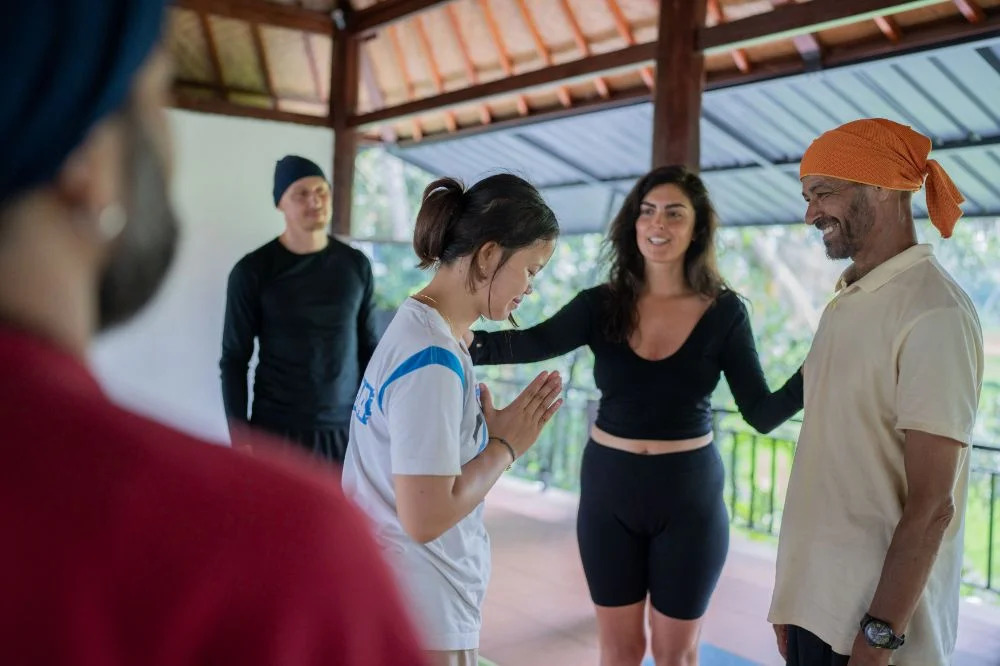
Yoga is usually felt through physical activity, breathing and meditation. But it’s not enough to just memorise postures or repeat instructions in order to understand these practices fully. The Yoga certification course is a combination of theory and practice, which helps students learn the principles of yoga and its responsible application. For prospective teachers, the balance between knowledge and experience is especially significant, as they need to convert their knowledge into effective, clear support for others.
Theory Gives Practice a Foundation
Theoretical learning helps students to understand beyond the visible movements of yoga. Anatomy, physiology, yogic philosophy and breathing techniques teach the principles which underpin a structured practice.For instance, future teachers can learn by studying anatomy, the way bodies move and why some people may feel different in the same posture. Yogic philosophy offers greater scope and understanding of discipline, self-study and awareness. These subjects provide context that can be missing from learning through physical practice.If this is not established, students can learn to follow instructions without comprehending what they are doing. Theory helps lead them to make more informed choices, identify their own limitations and ask questions when leading a class.
Practice Turns Knowledge Into Experience
It’s one thing to read about a posture; it’s another to feel it. Practical sessions enable students to examine alignment, balance, movement and breathing in their own experience through observation.It is also found from repeated practice that Yoga is not just a set of static forms. Posture feels different according to individual physical structure, concentration, strength and mobility. Such experiences enable students to develop an appreciation of the importance of flexible teaching.Students can also experiment with sequencing and transitions in their practical learning. They start to understand how one movement relates to another movement, how breathing can be used to help shape a sequence and how the speed of movement can affect the class experience.The goal is not to do away with theory in favour of experience, but for each to complement and reinforce the other.
Anatomy Connects Principles With Real Bodies
The relationship between theory and practice is most evident in anatomy. Joints, muscles and movement patterns can be covered in the classroom, but through practical sessions students can see how these are seen during yoga.Different ranges of motion can be seen between two people doing the same posture. As for the teacher, knowledge of anatomy will enable him to identify these differences, though he should never presume that all persons are identical.This view fosters safer and more judicious teaching. Rather than forcing students into a specific form, teachers may assist them to make sure they are set up in a good position for the exercise and feel good about it and the intention of the practice.This is the skill that a budding teacher needs to have: to relate what he’s learned through texts to what he sees.
Teaching Requires More Than Personal Experience
Self-practice can gain personal understanding, while teaching adds another responsibility: the need to transfer knowledge to those with varying needs and levels of practice.The teacher needs to make sure the movements are understood, clearly model the techniques, watch and adjust for participants. These skills are learnt in supervised teaching practice, with feedback and repetition.One student might know what to do in terms of the breathing, but have a hard time articulating it in very simple terms. Likewise, once a sequence is known, it does not necessarily make one a good guide for a group.Practice teaching provides an opportunity to identify these gaps. Feedback assists students to enhance their communication, timing, confidence and class responding skills.
Philosophy Becomes Meaningful Through Application
The balance between theory and practice is also an advantage of yogic philosophy. Knowledge of mindfulness and self-control/discipline and self-observation can be learnt in an intellectual sense, but when students consider daily habits and behaviour, then they should see the relevance.For instance, teaching in a consistent manner can foster discipline and awareness of practice can help students to identify their responses when things get difficult. Such experiences are not a substitute for the study of philosophy, but they can facilitate the link between ideas and life experiences.Teachers who delve into this connection can express philosophical concepts with greater nuance, avoiding slogans and definitions.
Feedback Creates a Learning Cycle
Yoga education is a process that is not linear from classroom to certification. It is a continuous process of learning, practising, observing and improving.Students practice a concept, observe the outcome, get feedback and revise the concept. This can be a way of identifying misunderstandings that may not have been identified during theoretical study.Constructive feedback also assists future teachers to see their weaknesses. They can consider errors as chances to expand their knowledge and teaching skills, rather than failure.This cycle fosters a more responsible approach to learning beyond school time.
Building a More Complete Teacher
A balanced yoga certification course should enable students to have physical awareness of their own practice, to gain knowledge of theory, to learn communication skills and to respect individual differences. They all help each other.There is a fine line between theory and practice. However, practice, if done without understanding, can be repetitive. When both are combined, students have a better idea of what yoga does and how it can be taught responsibly.
Final Words
A balance of theory and practice is essential to a meaningful yoga education. A Yoga Certification Course is significant when students can correlate the knowledge that they acquired in the field of anatomy, philosophy and personal experience to teaching.A yoga instructor is more than just learning and remembering yoga poses and completing assignments in class. It involves acquiring knowledge and experience to help direct others in an appropriate and responsible way. Learning is a continuous process when theory supports practice, while experience further strengthens knowledge, going beyond the training period.