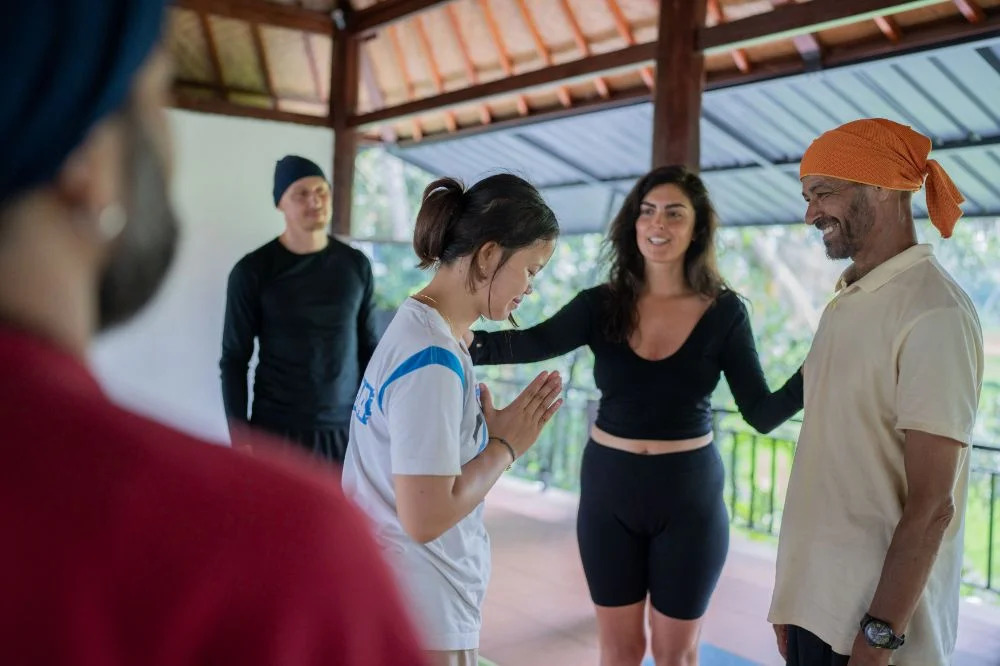
At some point in every worthwhile yoga journey, learning goes beyond personal experience to a deeper level. The mat becomes an area for learning to observe, to be disciplined and to be responsible. This is where yoga teacher training can help to make a difference for you – an identity change that extends beyond learning yoga postures. It prompts practitioners to rethink their movement, thinking, communication and response to their environment. It is not just some new job skill that is being obtained when a person becomes a yoga teacher. It can turn into an understanding of self in a new way.
From Practising Yoga to Embodying Its Principles
Usually, visible aspects of yoga practice are movement, flexibility, balance and breathing. Teacher training adds another dimension in asking why and how these practices are important to an individual’s overall state.
While studying alignment, anatomy, breathing methods, meditation and yogic philosophy, yoga becomes less about how the posture looks on the body. There is a gradual transition towards awareness. When a balanced pose opens up, it can be seen as an opportunity to observe concentration. A breathing exercise is a lesson in regulating attention. Stillness is no longer just an action; it is an experience.
This is significant, as the physical knowledge of the subject is not enough to make someone a proficient teacher. A teacher should be familiar with the experience to which the technique belongs. That in-depth knowledge can alter the student’s attitude towards yoga.
The Development of a Teacher’s Mindset
The most interesting thing about yoga teacher training is the evolution of a yoga teacher’s mind. Practitioners start to consider others’ experiences and begin to think beyond their own progress.
A comfortable posture for one person may be difficult for another. What works so well for one student may be unfamiliar to another in regard to a breathing exercise. Teachers are more likely to be observant, patient and adaptable because of these differences.
The attitude of teaching starts with listening. Rather than asking, “How do I do this properly,” the question becomes, “How can I convey this experience in a crystal-clear manner in a safe way? That change brings empathy into the practice.
The teacher discovers over time that teaching is not the act of demonstrating knowledge. It’s about making another person find something in themselves.
Knowledge Changes the Way the Body Is Seen
Yoga teacher training can also change the perception of the human body among practitioners. Students start to see movement as more than flexibility or looks, and introduce themselves to the complexities of joints, muscles, breathing patterns, posture and individual limitations.
Anatomy is used to develop more functional insights into movement. The concepts of alignment are no longer visual rules but are linked to function. Breath is no longer viewed as being outside the body but as an integral component of the movement and nervous system’s response.
This knowledge fosters an increased positive attitude toward individuality. There is no “perfect” yoga practitioner. All students come with their own physical history, structure, mobility and degree of awareness.
It is imperative for a future teacher to know these differences. It affords a smarter and more rational pedagogic way of teaching.
Philosophy Moves From Theory Into Daily Life
Yet another identity transformation is yogic philosophy. What can be abstract concepts can also become relevant to behaviour in everyday life.
Attitudes to discipline, awareness, contentment, self-study and detachment may slowly shape the way practitioners deal with stress, expectations and uncertainties. Philosophy becomes more than just a course or a class; it becomes a way of living.
Very profound teaching of yoga can begin to raise questions in the teacher’s mind about automatic behaviours, such as needing to keep comparing, needing to seem successful, or reacting rather than observing. The practice moves from gathering experiences and towards being aware of them.
Yoga education can impact the most at this very level. It is not noticeable in a photo. It shows in endurance, communication, decision-making, and being present in challenging situations.
Confidence Comes Through Understanding
It seems that many prospective teachers start training courses with the question in their minds that they are not ready to teach. They may doubt their voice, knowledge, or physical ability, and their ability to lead a group.
Training provides a setting that allows confidence to build without performance. The greater the students’ understanding of sequencing, communication and observation and adaptation, the more comfortable they will be in taking on responsibility.
Absolute trust is not the trust that all goes smoothly. It is the capacity to be calm, to know their own shortcomings and make sensible decisions. Such confidence is especially beneficial when engaged in dealing with individuals and their requirements and aspirations that are various.
A New Relationship With Responsibility
When teaching yoga, there is an important responsibility to shift into gear: the teacher can affect another person’s experience of movement, breathing and attention. Awareness of language, demonstration, pacing and individual boundaries are required.
The student’s identity can change as this responsibility becomes clear. Yoga need not be restricted to personal development. It turns into a way of serving, communicating and learning together.
The better the teachers, the more likely they are to still be students themselves. They persist in learning, questioning, and developing their knowledge, not assuming that certification is the end of learning.
Final Words
Yoga Teacher Training may not have a deeper meaning than the certificate you receive at the end of the course. It could be the identity that emerges, as it were.
The practitioner starts to perceive the body more, the mind more and other people more. Practice becomes teaching, knowledge becomes responsibility, and personal discipline becomes a way of interacting with the world.
This is why yoga teacher training can be more than just work training. It can turn into a quiet turning point in the life of a person; from “How well can I practise yoga?” to a more profound question for sure: “How consciously can I live and help others live that way?